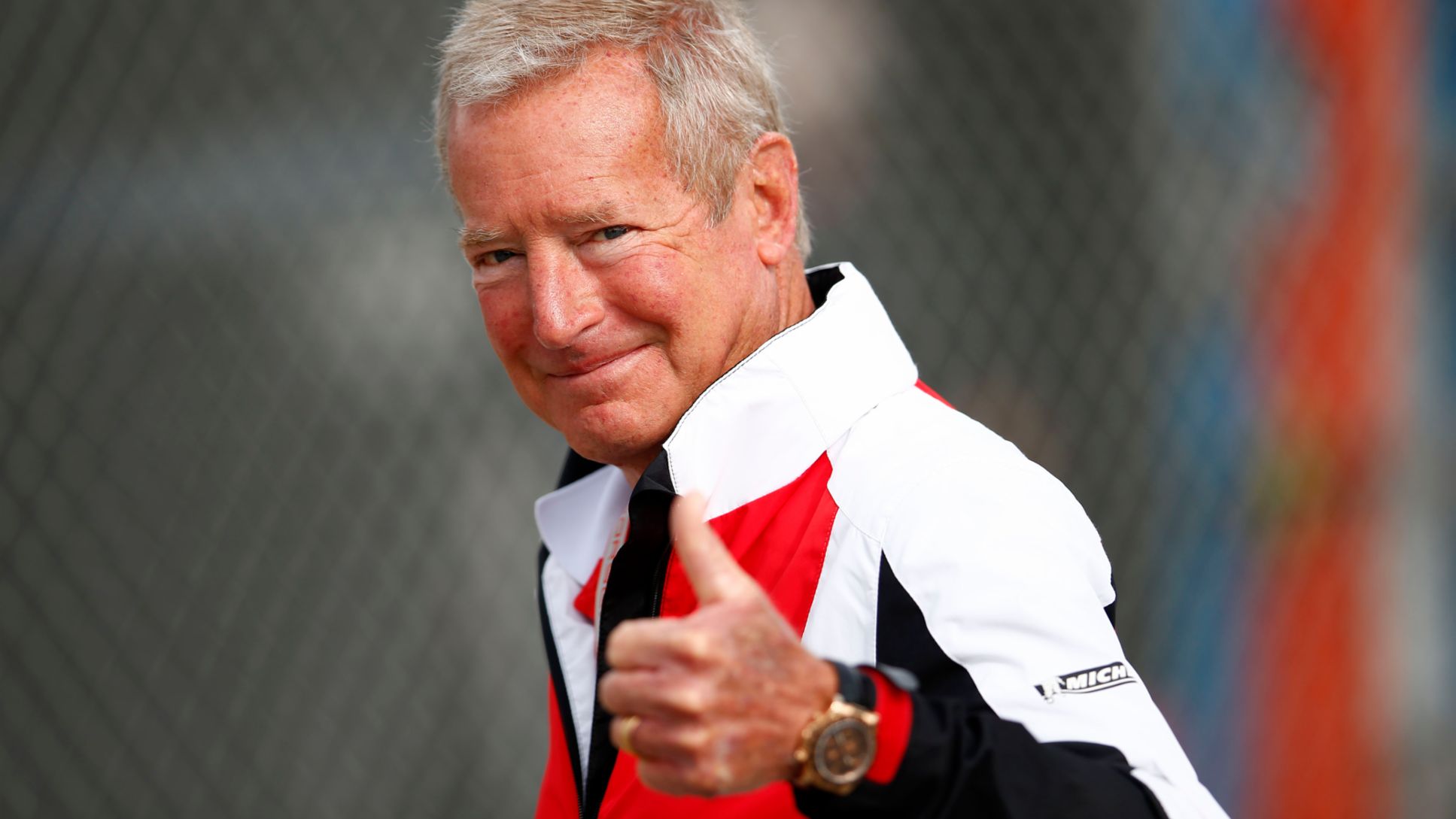
He won the 24 Hours of Le Mans in 1977 (Porsche 936), 1983 (Porsche 956) and 1994 (Dauer 962 Le Mans) and is tied as the most successful driver at the 24 Hours of Daytona with 5 wins (1973, 1975, 1977, 1979, and 1991). He won the 12 Hours of Sebring in 1973 and 1981. He also drove in the 1980 Indianapolis 500 finishing 18th. He represented IMSA four times in the International Race of Champions (1986, 1989, 1992, 1995). In 1970, he was drafted into the army where he served as Specialist 4 with the 164th Aviation Group near Saigon during the Vietnam War. After completing his tour of duty, he won his first IMSA GT title in 1971.
After Peter H. Gregg’s death, Haywood was a spokesperson and executive with Brumos Automotive dealerships.
He is the honorary chief driving instructor at the Porsche Track Experience, held at the Barber Motorsports Park outside Birmingham, Alabama. Patrick Dempsey produced a documentary film, Hurley, about Haywood’s life.
In honor of his historical achievements, he was invited to perform the ceremonial duties of Grand Marshal at the 2019 24 Hours of Le Mans.
Bill France Sr. once called Haywood a superhero, doing things “no one had ever done before.” In 1973, the career of Harris Hurley Haywood took off. Winning the Daytona and Sebring endurance classics – the “36 Hours of Florida” – back-to-back was the catalyst. Those victories had tentacles. They legitimized the faith his co-driver and Brumos Posche team owner, the more accomplished Peter Gregg, had in Haywood’s ability. The Florida sweep also back-handed naysayers of the dashing Porsche-driving duo. Glimpses of greatness will do that sort of thing. “That did change the course of my career, because it got the [serious] attention of Porsche,” Haywood said, 50 years later. “It was fun for me because I was 23 and I’d only been racing for two years. Suddenly, I was at Daytona in a factory car … that was a real learning curve for me and exciting. “After those races, Peter assigned me to the Porsche 917/10, which was a Can-Am car. I raced Can-Am in 1973 and finished third [in the series championship]. That was key to set my path with Porsche.” Haywood’s auto racing beginnings seem almost coincidental, perhaps even pre-ordained. In 1967 while attending Jacksonville University, he met Gregg at an autocross held in a Winn-Dixie parking lot where he hoped to turn heads in his pride-and-joy, a Chevrolet Corvette. Gregg’s turned. Haywood, all of 19 years old, beat him that day. “If destiny didn’t take me to a Winn-Dixie that day, what did?” Haywood asked. Destiny – let’s call it that – would eventually lead to a Porsche test at an actual racetrack, arranged by Gregg. Haywood was faster that day, too. “The plan was, he was going to show me how to drive,” Haywood said. In 1969, Haywood’s first race in a Porsche was at the famed Watkins Glen six-hour event, in a new 911 Gregg lined up for him, through the manufacturer. He and Gregg won their class, Grand Touring 2000.
The draft board could not have cared less about Porsche 911s. Haywood went to Vietnam in 1970, serving as a specialist 4 in the Army with the 164th Aviation Group near Saigon. He was back home in his native Chicago in time for Christmas, 1970. The rest is sports car history. Since retiring the distinctive red, white and blue Brumos livery in 2013, Haywood has continued to be visible in his sport. While he won races as a factory driver for Jaguar and Audi throughout his career, Haywood is most synonymous with Porsche and continues to serve as one of the manufacturer’s most revered ambassadors. Vintage races are a natural fit as are Grand Marshal appearances, including at Le Mans four years ago – and the Rolex 24 more than once. Daytona International Speedway, where he has found his most success, remains his self-proclaimed “home track.”
“I remember very distinctly driving through the tunnel for the very first time,” Haywood said. “Daytona actually was my very, very first race of my career. I was there for a regional sports car race [in the 1960s]. I remember rolling through that tunnel, coming up into the speedway and going, ‘Oh my God, what am I doing?’” What he was doing, was stepping over a threshold that would lead to auto racing immortality. Said Haywood: “I never dreamed in a million years that [my life and career] would turn into what it has.”